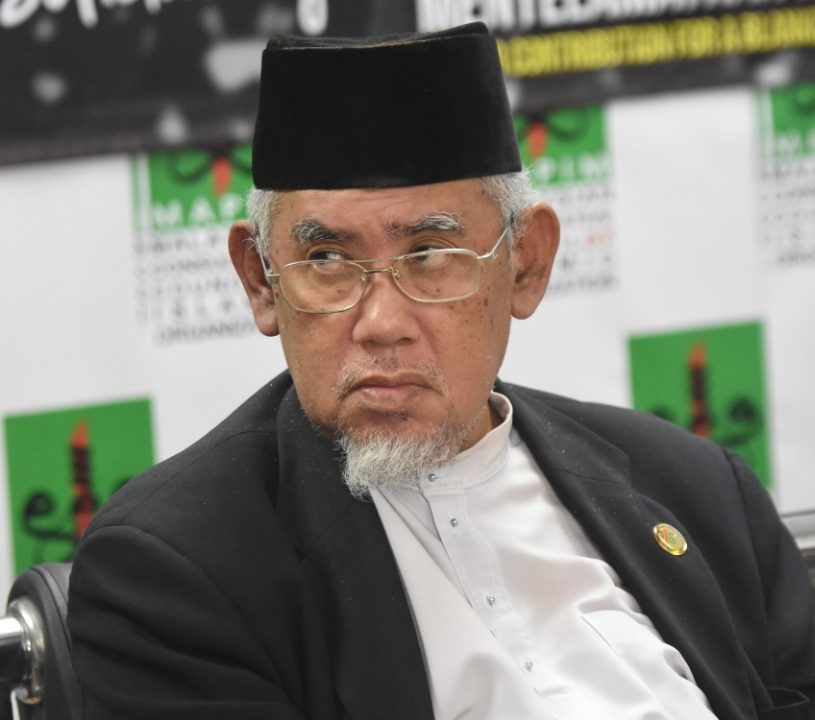
KUALA LUMPUR – US President Donald Trump’s description of the ongoing military conflict with Iran as “small potatoes” reflects a dangerous mindset in which the seriousness of war is measured by its political cost to powerful nations, according to Malaysian Consultative Council for Islamic Organisation (MAPIM) president Mohd Azmi Abdul Hamid.
Mohd Azmi said the statement should not be dismissed as merely another provocative remark as it raised serious questions over how human suffering is viewed during armed conflicts.
“There are moments in political history when a single sentence reveals more about the mentality of power than a thousand pages of policy documents,” he said.
He was referring to Trump’s remark when asked to describe the fighting, with the US president saying: “I call it a military conflict because it’s small potatoes for us. It’s not a big thing.”
According to Mohd Azmi, a war does not become less significant simply because a powerful leader chooses to describe it as a “military conflict”.
“A bomb does not become less destructive because it is described as an operation. A dead soldier does not become less dead because the number of casualties is considered relatively low,” he said.
He said the conflict was certainly not “small potatoes” for families who had lost loved ones, children exposed to explosions, mothers searching through the ruins of their homes or civilians forced to flee their communities.
“For the family of a soldier who never returns home, the conflict is not ‘small potatoes’. For a child who wakes up to explosions, it is not ‘small potatoes’,” he said.
Mohd Azmi also stressed that the true cost of war could not be measured solely through military casualties or financial expenditure.
He said civilian deaths and injuries, destroyed homes and infrastructure, displaced communities, psychological trauma among children and long-term economic damage must also be taken into account.
“The real cost must include the civilians caught in the conflict, the destruction of homes and infrastructure, the disruption of communities, the psychological trauma of children, the economic consequences and the long-term damage inflicted upon an entire society,” he said.
He further warned that reducing human suffering to statistics could make it easier for political leaders to treat war as a technical or military exercise.
“Casualties become percentages. Cities become targets. Families become collateral damage. Destruction becomes operational success or failure,” he said.
Mohd Azmi questioned who should have the authority to determine whether a war was “big” or “small”.
“Who decides whether a war is big?” he asked.
He said international law must also be applied equally to all countries regardless of their military strength or political influence.
“If international law is truly law, it must apply equally when its application is politically inconvenient,” he said.
Mohd Azmi also called for independent investigations into credible allegations of violations of international humanitarian law and stressed that military power should not shield any country from accountability.
“Military power cannot become a legal shield. Political influence cannot become immunity,” he said.
He said Malaysia, ASEAN, the Organisation of Islamic Cooperation (OIC) and the wider Global South should insist that no state was above international law.
“Without consequences, accountability is merely rhetoric,” he said.
Mohd Azmi warned that conflicts initially described as limited or manageable could eventually escalate into wider regional crises.
“Today’s ‘small conflict’ can become tomorrow’s dangerous precedent,” he said.
He said the world must reject any mindset that considered war acceptable simply because powerful states believed they could absorb its consequences.
“A missile is never small to the person beneath it. A wound is never small to the person carrying it. A dead soldier is never small to the family left behind,” he said.
He stressed that the international community must restore humanity to the centre of international affairs.
“The measure of civilisation is not the capacity to destroy. The measure of civilisation is the capacity to restrain destruction,” he said.
Mohd Azmi concluded that no country should be exempted from accountability and that the value of human life must never be determined by political or military power.
“No state is above international law. No government is above accountability. No victim is too small to matter,” he said.
“No human life is ‘small potatoes’.” – DETIK MALAYSIA
About the Author