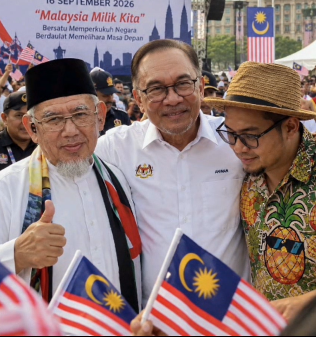
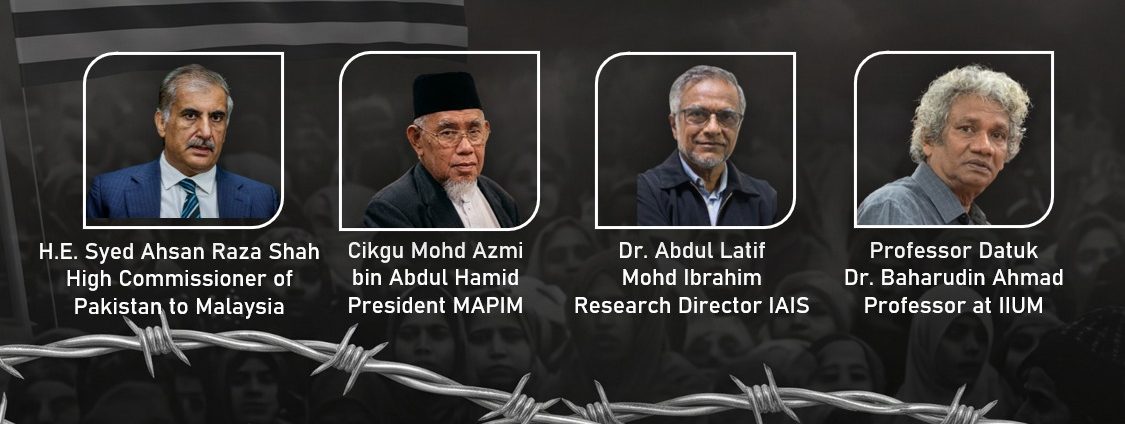
By MOHD AZMI ABDUL HAMID
President, Malaysian Consultative Council of Islamic Organizations (MAPIM)
KUALA LUMPUR – The Malaysian Consultative Council of Islamic Organizations (MAPIM) has called on the international community to renew efforts towards a peaceful resolution of the Kashmir dispute, stressing that the rights, dignity and aspirations of the Kashmiri people must not be ignored.
Its president, Mohd Azmi Abdul Hamid, said the commemoration of Kashmir Black Day must serve as a reminder of the decades-long conflict and the need for accountability, protection of human rights and respect for the right to self-determination.
He said the occasion, observed on October 27, marked 79 years since Indian troops landed in Srinagar on October 27, 1947, a development that became a defining moment in the history of Jammu and Kashmir.
“Your presence here today sends an important message: Kashmir must not be forgotten, and the suffering of its people must not be allowed to disappear from the conscience of the international community,” he said in his speech marking Kashmir Black Day 2026.
Azmi said generations of Kashmiris had endured conflict, displacement, bereavement, restrictions and uncertainty, while many families continued to seek truth and justice for their loved ones.
He stressed that the complexity of Kashmir’s history and its unresolved political and legal questions should not undermine the fundamental rights and dignity of the people affected by the conflict.
“Black Day is therefore a day of remembrance, but it must also be a day of accountability and renewed international responsibility,” he said.
Azmi said the Kashmir issue remained relevant to Malaysia and the wider international community because it raised fundamental questions about human dignity, international law and the right of people to determine their own future.
He said the international community must uphold the principles of justice consistently, regardless of geography, political influence or military strength.
Drawing comparisons with Palestine, Azmi said prolonged conflicts risked becoming normalised, with civilian suffering and displacement gradually pushed to the margins of international attention.
However, he acknowledged that Kashmir and Palestine had different historical and legal circumstances that must be examined separately.
He said the International Court of Justice’s advisory opinion on July 19, 2024, concerning the Occupied Palestinian Territory, reinforced the broader principle that territorial control and political power could not erase the rights of a people under international law.
On Kashmir, he called for a peaceful and just resolution consistent with relevant United Nations resolutions, applicable international law and the rights and aspirations of the Kashmiri people.
Azmi also highlighted concerns raised in reports published by the United Nations Office of the High Commissioner for Human Rights in 2018 and 2019 regarding the human rights situation in Indian-administered and Pakistan-administered Kashmir.
He called for credible, independent and impartial investigations into allegations of unlawful killings, enforced disappearances, torture, arbitrary detention and other serious violations.
He said victims and their families must have access to truth, effective remedies and justice, while independent human rights observers, journalists and civil society organisations should be able to carry out their work without undue restrictions.
“Accountability is not an act of revenge. It is a means of preventing further violations, restoring public confidence and establishing the truth,” he said.
Five commitments
Azmi said MAPIM reaffirmed its solidarity with the people of Kashmir and support for their right to self-determination in accordance with relevant United Nations resolutions and international law.
He outlined five key commitments, including upholding the right to self-determination, protecting human rights, renewing international engagement, strengthening coordinated action by the Muslim world and encouraging Malaysia to continue contributing through diplomacy and public advocacy.
He urged the United Nations, the Organisation of Islamic Cooperation (OIC), Muslim-majority countries and civil society organisations to intensify diplomatic engagement and keep Kashmir on the international agenda.
He added that Malaysia could contribute through principled diplomacy, academic engagement, humanitarian initiatives and cooperation with international partners.
Five initiatives proposed
Azmi also proposed five initiatives to translate the annual commemoration into sustained action.
They include establishing a Malaysia-Kashmir Civil Society and Academic Dialogue, strengthening public education and documentation, engaging Malaysian policymakers and international institutions, expanding humanitarian solidarity and launching a Kashmir Youth Leadership and Awareness Initiative.
He said universities, legal scholars, diplomats, human rights advocates and non-governmental organisations should work together to deepen public understanding of Kashmir’s history, international law and possible peaceful pathways towards a just resolution.
He also stressed the importance of verifying information and distinguishing established findings from reported allegations and matters requiring further investigation.
Addressing university students and young people, Azmi urged them to use research, education and digital platforms responsibly to raise awareness of neglected international issues.
He said solidarity with Kashmir should be grounded in knowledge, discipline and moral integrity, rather than misinformation, prejudice or hostility towards ordinary Indian citizens and other communities.
“The struggle for justice requires courage, but it also requires discipline, knowledge, patience and moral integrity,” he said.
Azmi stressed that the future of Kashmir must not be discussed without the participation and aspirations of the Kashmiri people.
Concluding his speech, he urged the international community to sustain its attention on Kashmir and pursue a peaceful resolution grounded in justice and international law.
“We do not seek hatred between peoples. We seek justice between peoples.
“We do not seek endless conflict. We seek a just and lasting peace.
“We do not seek to impose a future upon Kashmir. We seek a future in which the rights, dignity and aspirations of the Kashmiri people are genuinely respected,” he said.
He added that Kashmir must not be forgotten and that the right to self-determination must not be denied indefinitely. – DETIK MALAYSIA
About the Author